
- 01
- May
- 2026
The 20th Century American Coin Renaissance
Charles E. Barber was the Sixth Chief Engraver of the United States Mint, succeeding his father at that post and serving at that post for thirty-eight years, from 1879 until his death in 1917. Charles Barber designed the Liberty “V” Nickel as well as the Barber Dime, Quarter, and Half Dollar, all of which were in production at the dawn of the twentieth century. Barber prioritized the production, durability, and functional design of coinage over its artistry. He chose designs that could be struck efficiently for mass production, and that would remain recognizable even with extensive wear.
However, Barber’s designs were seen as pedestrian in contemporary artistic circles. On December 27, 1904, President Theodore Roosevelt sent a letter to the Secretary of the Treasury in which he stated that the nation’s coinage was “hideously atrocious” and that he wished to employ Augustus Saint-Gaudens to beautify the United States coinage. This letter marked the beginning of the Twentieth-Century American Coin Renaissance.
President Roosevelt commissioned noted sculptor Augustus Saint-Gaudens to redesign the entire American coinage spectrum from the cent to the double eagle. In failing health, Saint-Gaudens was able to complete or nearly complete work for just two denominations, the $20 Saint-Gaudens Double Eagle and the $10 Indian Eagle, both of which were first struck in 1907. A student of Saint-Gaudens, Bela Lyon Pratt, designed the $5 Indian Half Eagle and $2½ Quarter Eagle, the former being first struck in 1908 and the latter in 1909.
The Saint-Gaudens $20 Double Eagle
The first coin of the Twentieth-Century American Coin Renaissance was the $20 Saint-Gaudens Double Eagle, designed by Augustus Saint-Gaudens and minted from 1907 until 1933, when the United States outlawed private ownership of gold. It is generally regarded as the most beautiful coin ever produced by the United States Mint.
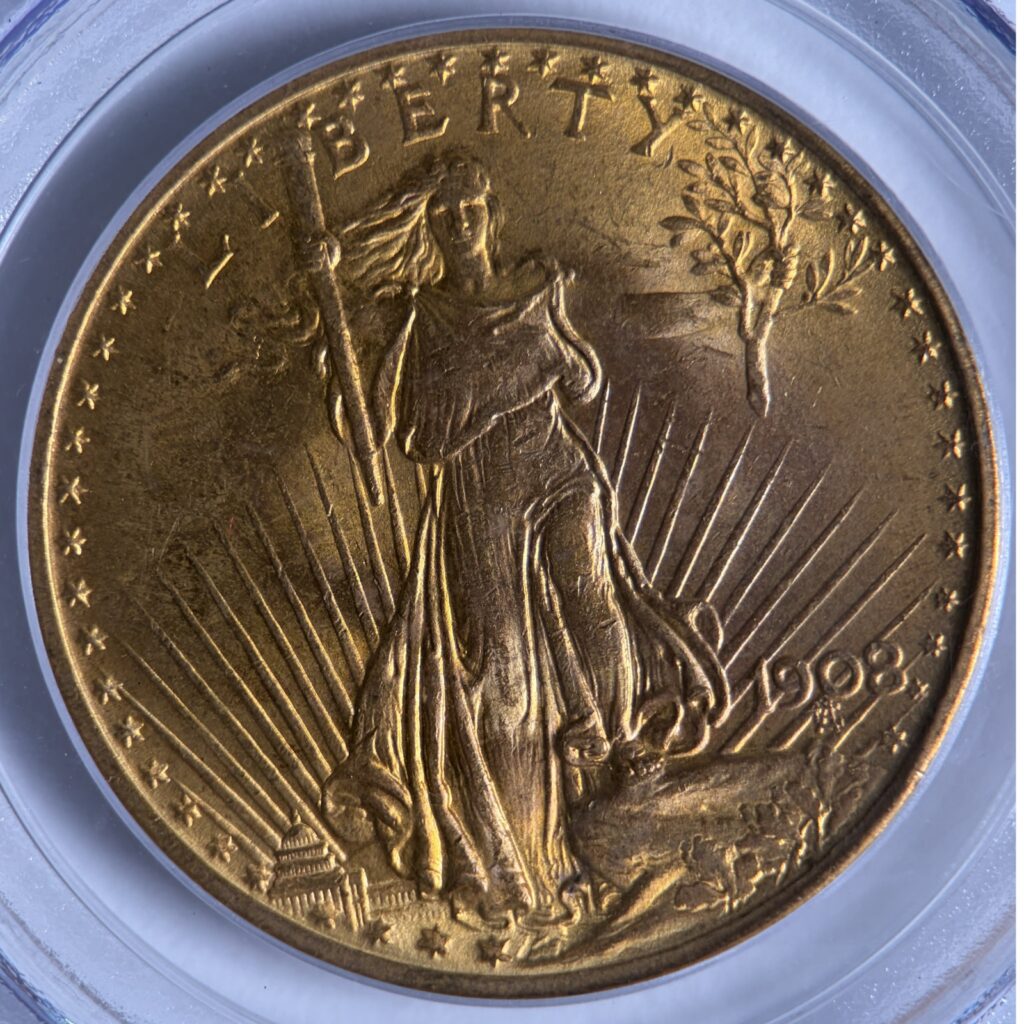
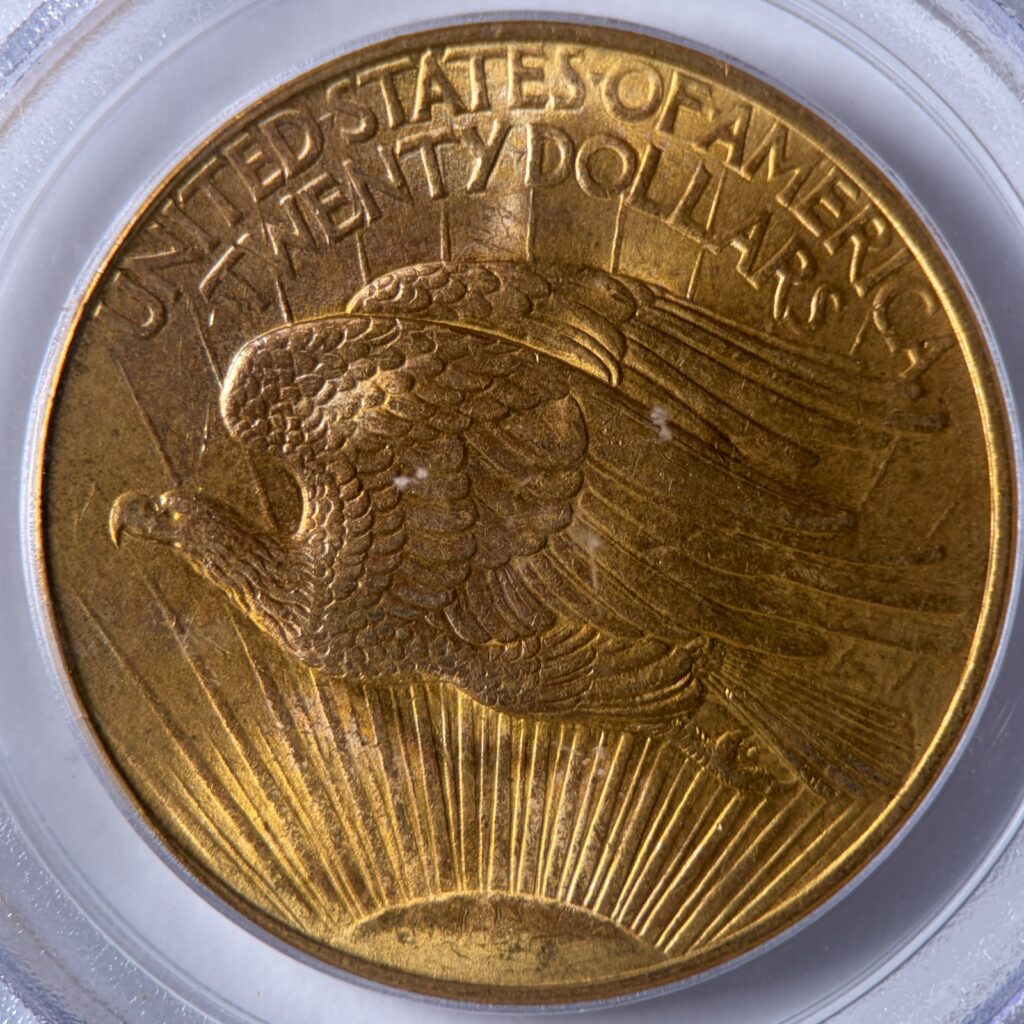
As described by the United States Mint, the obverse depicts Lady Liberty as a statuesque woman striding powerfully forward. Her robe harkens back to our roots as a republic, rooted in the ideals of ancient Greece and Rome. She is leading the way with a torch in her front hand and an olive branch in her back hand. This design underscores that liberty is central to the American spirit, is beautiful and attractive to all, and wherever Lady Liberty goes, inspired by enlightenment, peace follows. The United States Capitol dome is also depicted in the background, meaning that through representative democracy, liberty has been fully achieved in the United States, strengthening its position to go forth throughout the world. The reverse depicts a young eagle flying during a sunrise. This is the United States, young and strong, in its ascendancy with a bright future before it. The motto, “E PLURIBUS UNUM,” is on the edge of the coin, allowing a cleaner design on the obverse and reverse.
Excluding the ultra-high relief specimen coins, the Saint-Gaudens $20 Double Eagle had three different designs in its first year. The higher relief designs required several strikes to produce and could only be produced in limited numbers. The high-relief design was replaced with a lower-relief design better suited to mass production.
The Coinage Act of 1865 authorized the United States Mint to place the motto “IN GOD WE TRUST” on gold and silver coins when sufficient space was available. It did not mandate the placement. President Theodore Roosevelt believed it was inappropriate to place this motto on coins that might be used for illicit activities and directed its exclusion on the Saint-Gaudens $20 Double Eagle and the $10 Indian Eagle. This created a public outcry, prompting Congressional legislation mandating its return and leading to the third design of the Saint-Gaudens $20 Double Eagle that first year. The exemplar here is one of the “godless” coins featuring the modified low-relief design.
The $10 Indian Eagle
The second coin of the Twentieth-Century American Coin Renaissance was the $10 Indian Eagle Double Eagle, designed by Augustus Saint-Gaudens and minted from 1907 until 1933.

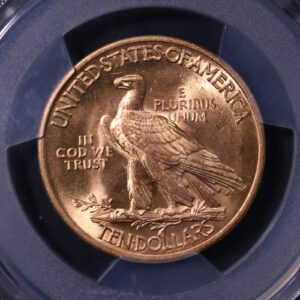
The obverse depicts a female wearing an Indian war headdress. The reverse depicts an eagle perched on a branch. Bela Lyon Pratt used a modification of this design on the $2.50 Indian Quarter Eagle and $5 Half Eagle gold pieces.
The $10 Indian Eagle had three different designs in its first year. The first two designs were high-relief designs that had the same production issues as the $20 Saint-Gaudens Double Eagle. The third design had lower relief, making it more suitable for mass production. The following year, the coin was redesigned a fourth and final time, adding the motto “IN GOD WE TRUST” to the reverse. The exemplar here includes that motto.
The $5 Indian Half Eagle and $2 ½ Quarter Eagle
The next coins of the American Coin Renaissance to be issued were the $5 Indian Half Eagle, designed by Bela Lyon Pratt, and minted from 1908 until 1916 and then again in 1929, and its smaller sibling, the $2 ½ Indian Quarter Eagle, which was minted from 1909 until 1915 and then again from 1925 until 1929. These coins are unique in United States coinage as they are the only incuse-designed coins ever produced by the United States Mint. An incuse-designed coin is a coin where the relief (i.e., the coin’s design) is sunken below the field (i.e., the flat surface of the coin) rather than raised above the field. It was believed that the design would increase the coin’s durability and discourage counterfeiting.
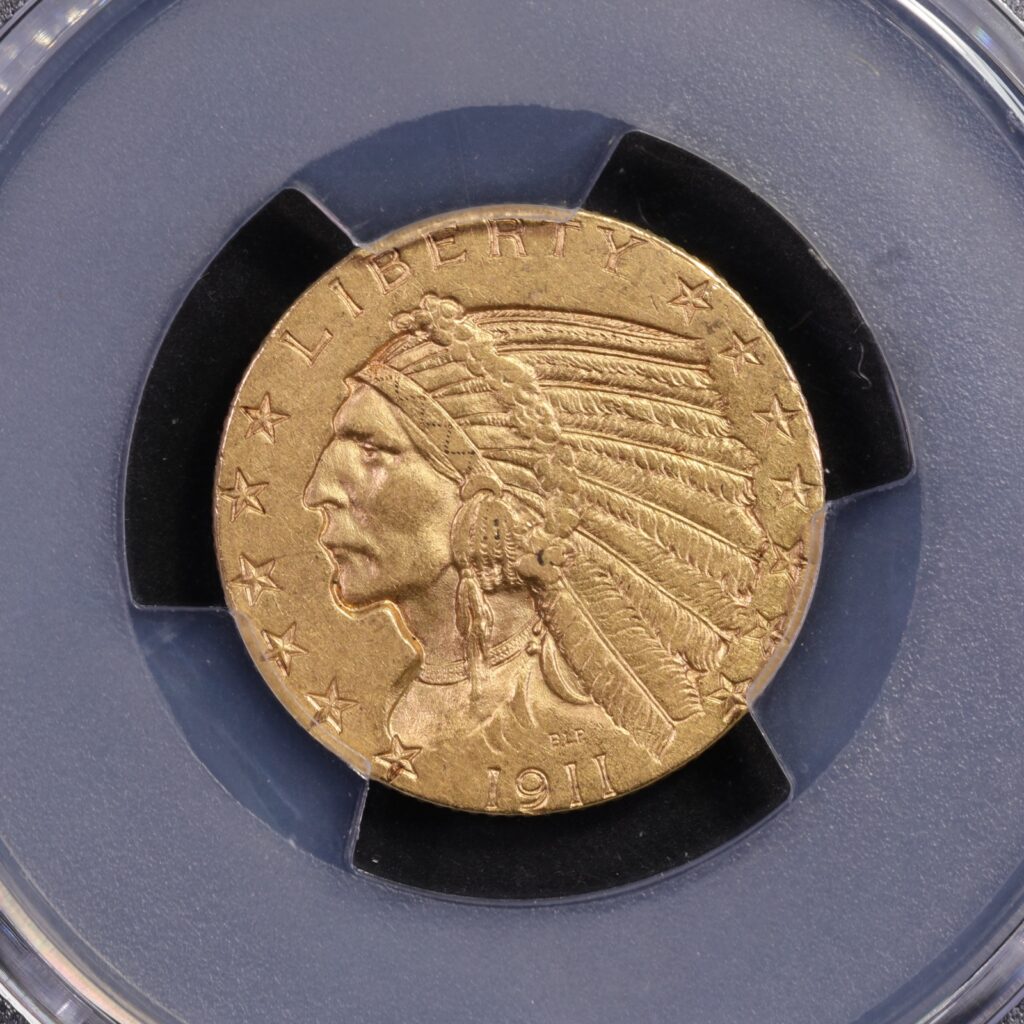
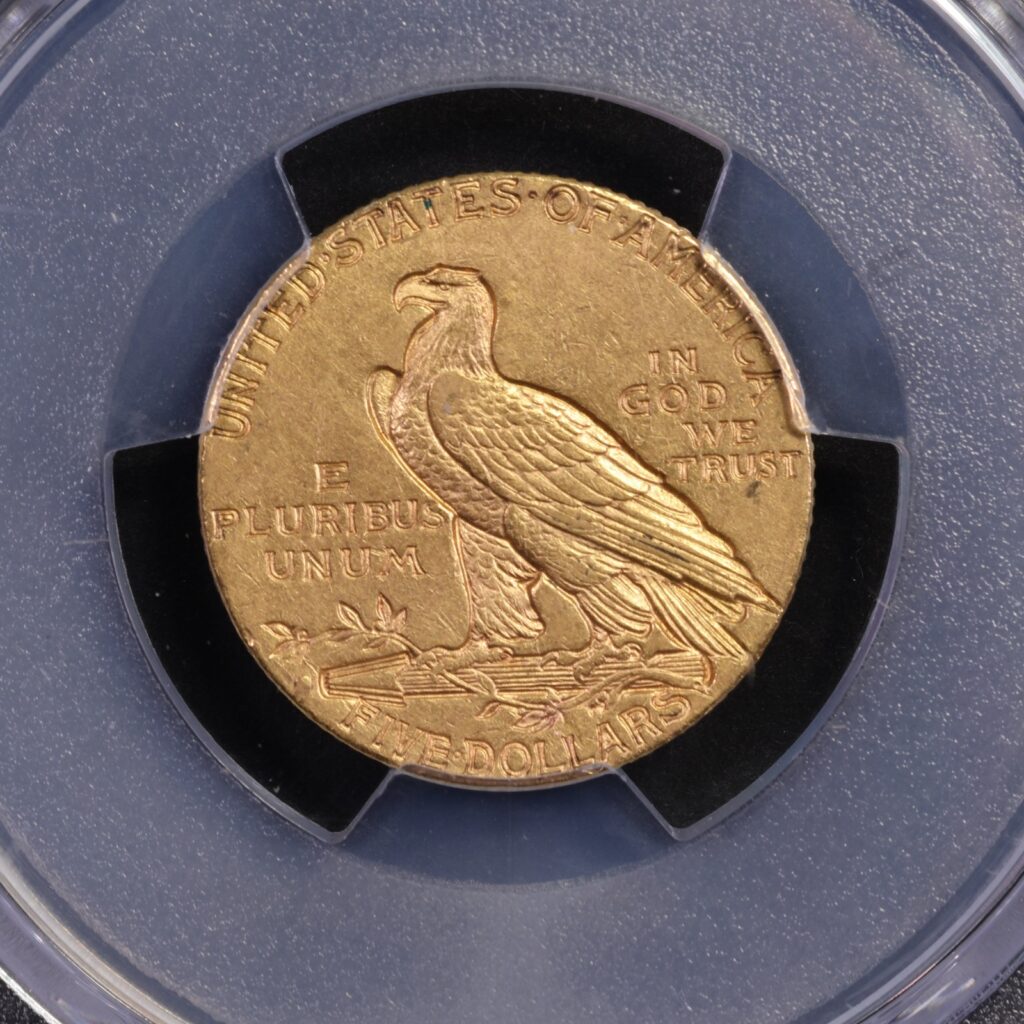
The obverse depicts a left-facing portrait of a Native American chief wearing a full-feathered headdress, surrounded by 13 stars, the date, and LIBERTY. The design was an adaptation of Saint Gaudens’ $10 Indian Eagle. The reverse depicts a bald eagle perched atop a bundle of arrows entwined with an olive branch, symbolizing strength and peace. Inscriptions include “UNITED STATES OF AMERICA”, “E PLURIBUS UNUM,” “IN GOD WE TRUST,” and “FIVE DOLLARS.”
Over the next two decades, all circulating coins in the United States were redesigned, the new designs including the $20 Saint-Gaudens Double Eagle (1907), the $10 Indian Eagle (1908), the $5 Indian Half-Eagle (1908), and the $2 ½ Indian Quarter-Eagle (1908) above as wall as the Lincoln Cent (1909), the Buffalo Nickel (1913), the Mercury Dime (1916), the Standing Liberty Quarter (1916), the Walking Liberty Half-Dollar (1916), and the Peace Dollar (1921).
References
American Numismatic Association. (n.d.) The Renaissance of U.S. Coinage. https://www.money.org/money-museum/virtual-exhibits-hom-case27.
Morgan, Charles, and Hubert Walker. (June 28, 2024). Coin Week. Indian Head Half Eagle, 1908-1929. https://coinweek.com/indian-head-half-eagle-1908-1929.
Professional Coin Grading Service Coin Facts. (nd). Indian $5. https://www.pcgs.com/coinfacts/category/gold-coins/indian-5-1908-1929/771
Professional Coin Grading Service Coin Facts. (nd). Indian $10. https://www.pcgs.com/coinfacts/category/gold-coins/indian-10-1907-1933/65
Professional Coin Grading Service Coin Facts. (nd). St. Gaudens $20. https://www.pcgs.com/coinfacts/category/st-gaudens-20-1907-1933/67.
The United States Mint. (nd) Ultra High Relief Double Eagle Gold Coin. https://www.usmint.gov/learn/coins-and-medals/collectible-coins/double-eagle.