
- 01
- May
- 2026
The Great Seal of the United States
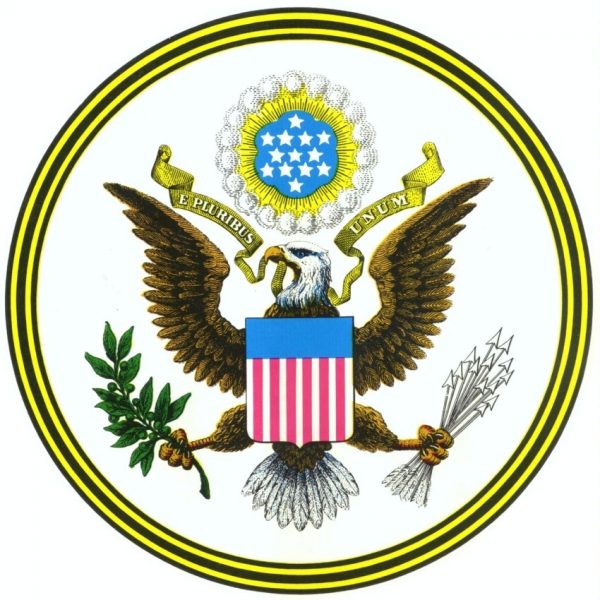
One of the first lessons taught in numismatic courses is that the designs and inscriptions on coins symbolize a nation’s identity, values, and history. With the Treaty of Paris signed in 1783, ending the Revolutionary War, the United States Constitution having been ratified in 1787, and the Bill of Rights having been ratified in 1791, the ideals found in the Declaration of Independence of liberty and self-governance were paramount to the Founding Fathers.
However, before the United States of America was created under the United States Constitution, ratified in 1789, even before there was the United States of America under the Articles of Confederation, adopted in 1781, there was the Continental Congress, the governing body that coordinated the thirteen colonies’ resistance to British Rule between 1774 and 1781. In addition to drafting and adopting the Articles of Confederation, the Continental Congress’s key accomplishments include establishing the Continental Army in 1775 and declaring independence from Great Britain on July 4, 1776.
Hours after adopting the Declaration of Independence, declaring itself a sovereign nation, the Continental Congress appointed Benjamin Franklin, Thomas Jefferson, and John Adams to design a seal for the new nation to authenticate official documents.Their initial designs were rejected, and it wasn’t until 1882 that the Continental Congress, then the Congress of the Confederation, approved the final design for the obverse of the Great Seal, based on a drawing by then-Secretary of the Congress Charles Thompson.

The symbolism and inscriptions on the obverse of the Great Seal have been the source of much of the symbolism on United States Coinage. The obverse depicts an American bald eagle clutching an olive branch with thirteen olives and leaves and thirteen arrows. The eagle symbolizes strength, independence, and freedom. The olive branch and arrows symbolize the power of peace and war, respectively, with the eagle facing towards peace. This design cemented the American eagle as a national symbol. Borne on the eagle’s breast is a shield, now known as the Union Shield, with thirteen red and white stripes beneath a blue bar, representing the thirteen original states. The colors symbolize hardiness (red), purity (white), and vigilance/justice (blue). The thirteen stars above, surrounded by clouds, represent a new nation taking its place among sovereign powers. The national motto, “E Pluribus Unum,” signifies the creation of a single, unified nation from thirteen distinct, separate colonies.
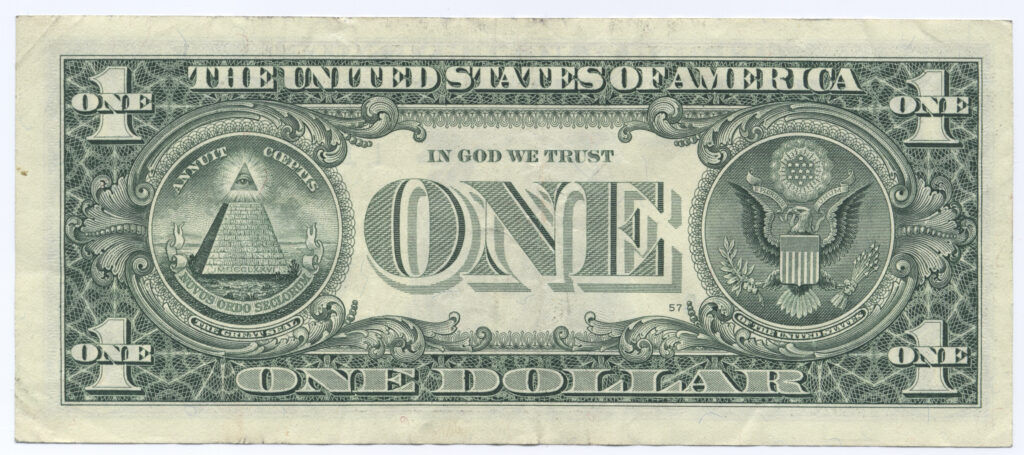
An impression of the obverse is used to authenticate official documents, including the passports held by many of us. The lesser-known reverse, with an unfinished pyramid, the eye of providence, and the date 1776 in Roman numerals, has no such official use, and no reverse die has ever been made. The reverse, however, along with the obverse, can be found on the back of the one-dollar bill.
References
National Museum of American Diplomacy. (March 19, 2018)The Great Seal. https://diplomacy.state.gov/the-great-seal